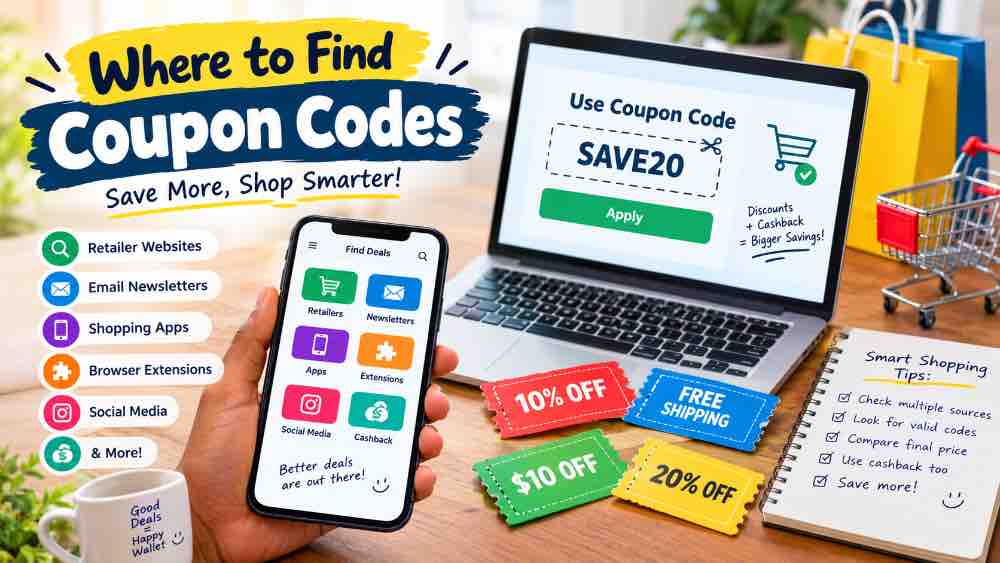
Finding a coupon code can sometimes feel like searching for your phone while you are holding it.
You search Google, open five websites, copy a code, reach checkout, paste it in—and suddenly you are greeted with the dreaded “Invalid promotional code.”
Fortunately, finding coupon codes does not have to be that frustrating.
Coupon codes can come from retailer websites, coupon databases, email newsletters, shopping apps, browser extensions, social media accounts, loyalty programs, cashback platforms, and even your credit card provider. The trick is knowing where to look and how to identify offers that actually apply to your purchase.
In this guide, we’ll explain where to find coupon codes, how to find legitimate discounts, how to use promo codes online, and how to combine coupons with cashback to potentially stretch your shopping budget further.
What Is a Coupon Code?
A coupon code is a combination of letters, numbers, or words that shoppers enter during checkout to receive a particular promotion.
Depending on the retailer, a coupon code might provide:
- A percentage discount
- A fixed-dollar discount
- Free shipping
- A free item
- A buy-one-get-one promotion
- A new-customer discount
- A seasonal discount
- A loyalty-member offer
For example, a retailer might offer a code such as SAVE20 for a percentage discount on qualifying purchases.
However, coupon codes usually come with conditions. A code might require a minimum purchase, apply only to selected products, or be available only to new customers.
That’s why finding a code is only half the battle. Finding one that matches your purchase is the real victory.
Where to Find Coupon Codes Online
If you’re wondering where to find coupon codes, start with these sources:

- Retailer websites
- Coupon websites
- Retailer apps
- Email newsletters
- Browser extensions
- Social media
- Loyalty programs
- Search engines
- Cashback websites
- Credit card offers
Coupon availability changes frequently, so it is worth checking more than one source before paying.
Retailer websites and apps are particularly useful because merchants often publish their own promotional offers there. Coupon databases and browser extensions can also help shoppers discover codes without manually checking every retailer.
1. Check the Retailer’s Website First
Before hunting around the internet, visit the store where you intend to shop.
This sounds ridiculously obvious, which is exactly why people sometimes forget to do it.
Look for sections such as:
- Deals
- Coupons
- Promo Codes
- Offers
- Sale
- Clearance
- Special Offers
- New Customer Offers
Some retailers display promotional codes directly on their homepage, while others provide discounts after you create an account or join their loyalty program.
This can also be a safer starting point because you are getting the promotion directly from the retailer.
Tip: Check the retailer’s homepage immediately before checkout. A banner you didn’t notice earlier might suddenly be offering free shipping or a percentage discount.
2. Sign Up for Store Email Newsletters
Email newsletters are another excellent place to find coupon codes.
Many retailers use email subscriptions to send customers:
- Welcome discounts
- Exclusive promo codes
- Flash-sale notifications
- Seasonal offers
- Free-shipping promotions
- Early access to sales
Some stores offer a discount simply for joining their mailing list.
You don’t necessarily need to become emotionally attached to every retailer’s newsletter, either. If the emails become too enthusiastic, you can unsubscribe later.
Pro tip
Create a separate shopping email address if you frequently subscribe to retailer newsletters. That way, your primary inbox doesn’t turn into a digital shopping mall.
3. Use Coupon Websites
Dedicated coupon websites collect promotional codes and deals from different retailers.
Instead of searching each store individually, you can search for the retailer and browse available promotions.
This is particularly useful when you already know where you want to shop but don’t know whether a coupon exists.
Search for phrases such as:
- [Store Name] coupon code
- [Store Name] promo code
- [Store Name] discount code
- [Store Name] free shipping code
- [Store Name] first order discount
But don’t assume that every code you find is still active.
Coupon databases can contain expired or restricted offers, so always check the expiration date and terms before relying on a code.
4. Download Retailer Apps
Your favorite retailer’s mobile app could be hiding discounts in plain sight.
Many shopping apps feature:
- App-exclusive coupons
- Digital coupons
- Member-only offers
- Flash sales
- Personalized promotions
- Free-shipping deals
Retailer apps have become increasingly important for digital coupons, particularly for shoppers looking for in-store savings.
Before making a purchase, open the retailer’s app and check the offers section.
You might discover a discount sitting there quietly while your wallet is preparing for battle.
5. Try Coupon Browser Extensions
If manually searching for coupon codes sounds like work, browser extensions can do some of the detective work for you.
Some shopping extensions can search for available coupon codes when you reach checkout and test applicable offers.
Examples of coupon and shopping extensions covered by consumer-finance publications include Honey, Capital One Shopping, RetailMeNot and other coupon-finding tools.
The basic process is usually:
Shop online → add products to your cart → proceed to checkout → activate the extension → check available coupons.
One important warning
Don’t assume the first discount shown is automatically the best deal.
Check the actual final price, shipping cost, cashback opportunity and coupon restrictions before completing your purchase.
6. Follow Brands on Social Media
Your favorite brands may publish promotional codes on social media.
Check platforms such as:
- TikTok
- X
- YouTube
Brands sometimes use social media to announce:
- Flash sales
- Limited-time promo codes
- Influencer discounts
- New-product promotions
- Holiday deals
- Exclusive follower offers
NerdWallet also identifies social media as a potential source for retailer and influencer promotional codes.
The downside?
You may have to scroll through several videos of people dancing next to products before finding the actual discount.
Such is the price of modern coupon hunting.
7. Check Your Loyalty and Rewards Account
If you regularly shop with a particular retailer, joining its loyalty program can unlock additional offers.
Loyalty programs may provide:
- Member-only coupons
- Personalized discounts
- Birthday offers
- Points
- Free shipping
- Early sale access
- Special promotions
This is especially useful for retailers you already use frequently.
And if you are interested in getting more value from your everyday spending, don’t stop at coupons.
For example, CashbackFlip’s Cashback Explained: The Ultimate Guide to Earning Money Back on Every Purchase explains how cashback works and how shoppers can incorporate cashback opportunities into their normal shopping routine.
8. Look for First-Order Coupon Codes
New customers are often targeted with introductory offers.
Common examples include:
- 10% off your first order
- 15% off your first purchase
- $10 off orders over a certain amount
- Free shipping on your first order
If you have never purchased from a retailer before, check whether it offers a new-customer promotion.
However, read the conditions carefully.
Creating multiple accounts solely to repeatedly claim new-customer discounts may violate a retailer’s terms.
9. Search for Student, Military, or Membership Discounts
Some retailers offer special discounts to eligible groups.
Depending on the retailer and country, these can include discounts for:
- Students
- Teachers
- Military personnel
- Healthcare workers
- Seniors
- Members of professional organizations
These offers aren’t always advertised prominently, so search the retailer’s website for eligibility-based discounts before checking out.
10. Check Your Credit Card Offers
Your credit card provider may have merchant-specific offers available through your online account or banking app.
These aren’t traditional coupon codes, but they can still reduce the effective cost of a purchase.
Depending on the card issuer and offer, you may need to activate the promotion before making the purchase.
That creates an important rule:
Check your card offers before—not after—you buy.
Once the transaction has already happened, discovering that you could have activated an offer beforehand is about as useful as finding an umbrella after the rain stops.
11. Use Cashback Websites Alongside Coupons
Coupons reduce the price you pay.
Cashback can potentially return part of your qualifying spending afterward.
That makes cashback an important part of the coupon-hunting process.
For example:
Original price: $100
Coupon: 15% off
Discounted price: $85
Cashback: 5% of eligible spending
Potential cashback: $4.25
The exact result depends on the retailer’s terms, eligible products, exclusions and cashback rules.
Before using both, check whether the coupon qualifies for cashback. Some retailers may exclude purchases made using certain promotional codes.
How to Find Coupon Codes That Actually Work
Finding a coupon is one thing.
Finding a working coupon is another.
Before copying a code, look for:
1. Expiration date
Don’t waste ten minutes trying a coupon that expired six months ago.
2. Minimum purchase
A “$20 off” coupon might require a $100 purchase.
3. Product restrictions
The coupon might exclude sale items, gift cards, electronics or certain brands.
4. Customer restrictions
Some codes are limited to new customers or members.
5. Geographic restrictions
A promotion available in one country may not work in another.
6. Usage limits
Some promotional codes can only be used once per customer.
7. Payment restrictions
Occasionally, a promotion may require a particular payment method.
Always read the terms before assuming a code applies to your order.
Why Some Coupon Codes Don’t Work
You found the code.
You copied it.
You pasted it.
And checkout responded:
“This promotion is not valid.”
Welcome to couponing.
There are several possible reasons.
The code expired
Retailers regularly end promotional campaigns.
The code applies to different products
A code might work only on selected products.
You haven’t met the minimum spend
For example, a $15 discount could require a $75 purchase.
You’re not an eligible customer
Some offers are restricted to new customers or loyalty members.
Another promotion is already applied
Some retailers don’t allow multiple discounts to be combined.
The code is region-specific
A coupon created for shoppers in one country may not work elsewhere.
The coupon website is outdated
Third-party coupon sites may list offers after they have expired.
This is one reason to verify promotions before completing your order.
How to Avoid Fake Coupon Codes
Not every website displaying a giant “90% OFF!!!” banner deserves your trust.
When looking for coupon codes:
- Prefer reputable coupon websites.
- Check the retailer’s official website.
- Look for expiration dates.
- Read coupon restrictions.
- Avoid suspicious downloads.
- Don’t provide unnecessary personal information.
- Be cautious of websites demanding payment for ordinary coupon codes.
- Compare the final price rather than trusting the advertised percentage.
CashbackFlip’s editorial policy also notes that coupon availability and expiration dates can change and encourages readers to verify offers directly with retailers or cashback providers before purchasing.
Can You Use a Coupon Code and Cashback Together?
Sometimes, yes.
But it depends on the cashback provider and retailer.
This is commonly called stacking savings, where you combine different types of promotions on the same purchase.
A potential savings strategy could look like:
Sale price + coupon code + cashback + loyalty rewards
However, there is an important catch: some coupon codes can make a transaction ineligible for cashback.
Therefore, always check the cashback terms before applying an unfamiliar promotional code.
Don’t chase a 20% coupon only to discover that you accidentally lost 10% cashback.
The calculator has feelings too.
⸻
A Simple Coupon-Finding Routine
You don’t need to spend an hour hunting for a $3 discount.
Try this simple routine before buying something online.
Step 1: Check the retailer
Look for current promotions and coupon banners.
Step 2: Check your account
Look for loyalty rewards and personalized offers.
Step 3: Search for a coupon
Search the retailer name plus “coupon code” or “promo code.”
Step 4: Check a coupon extension
See whether your browser can identify additional offers.
Step 5: Check cashback
Before purchasing, see whether cashback is available.
Step 6: Compare the final price
Don’t automatically choose the largest-looking coupon.
Compare:
Price after coupon + shipping − cashback − other applicable savings
The lowest legitimate final cost is what matters.
Frequently Asked Questions
Where is the best place to find coupon codes?
Start with the retailer’s official website and app, then check reputable coupon websites, browser extensions, email offers and cashback platforms.
No single source will have every available promotion.
How do I find coupon codes for online shopping?
Search for the retailer’s name alongside terms such as “coupon code,” “promo code,” “discount code” or “free shipping.” You can also use coupon browser extensions that search for available offers during checkout.
Are coupon websites free?
Many coupon websites allow shoppers to search for codes without paying. However, some websites may make money through advertising or affiliate partnerships.
Why do coupon codes expire?
Retailers use coupons for limited-time marketing campaigns. Once the promotion ends, the code may stop working.
Can I use multiple coupon codes at once?
Sometimes, but it depends entirely on the retailer’s coupon policy. Some merchants allow coupon stacking while others permit only one promotional code per order.
Do coupon codes work on sale items?
It depends on the individual promotion. Some coupons apply to sale items while others specifically exclude them.
Is cashback better than a coupon?
They serve different purposes. A coupon generally reduces the purchase price immediately, while cashback typically rewards eligible spending after or around the transaction. In some cases, shoppers may be able to use both.
Final Thoughts: Where to Find Coupon Codes
Finding coupon codes doesn’t require becoming a full-time internet detective.
Start with the retailer’s website, check its app and email offers, search reputable coupon databases, use browser extensions when appropriate, and look at loyalty and cashback opportunities before completing your purchase.
Most importantly, don’t judge a coupon by its headline percentage.
A 30% coupon with a $100 minimum purchase isn’t necessarily better than a 10% coupon with no minimum. And a coupon that removes your eligibility for cashback may not produce the lowest final cost.
The goal isn’t simply to find a coupon.
The goal is to pay less.
And if you’re building a bigger money-saving strategy, combine coupon hunting with cashback, rewards programs and smart shopping habits. That’s where small savings can become much more meaningful over time.