How Much Should I Have Saved by 30?
Turning 30 can come with a strange financial reality check. One minute you’re enjoying life, and the next you’re wondering, “Wait… how much money should I actually have saved by now?” If your savings account doesn’t look like a small fortune, don’t panic—you’re definitely not alone.
There’s no single magic number for how much money you should have saved by 30. Your income, location, monthly expenses, debt, family responsibilities, and when you started working all make a difference. Still, having a financial benchmark can help you understand whether you’re on track and what you may need to change.
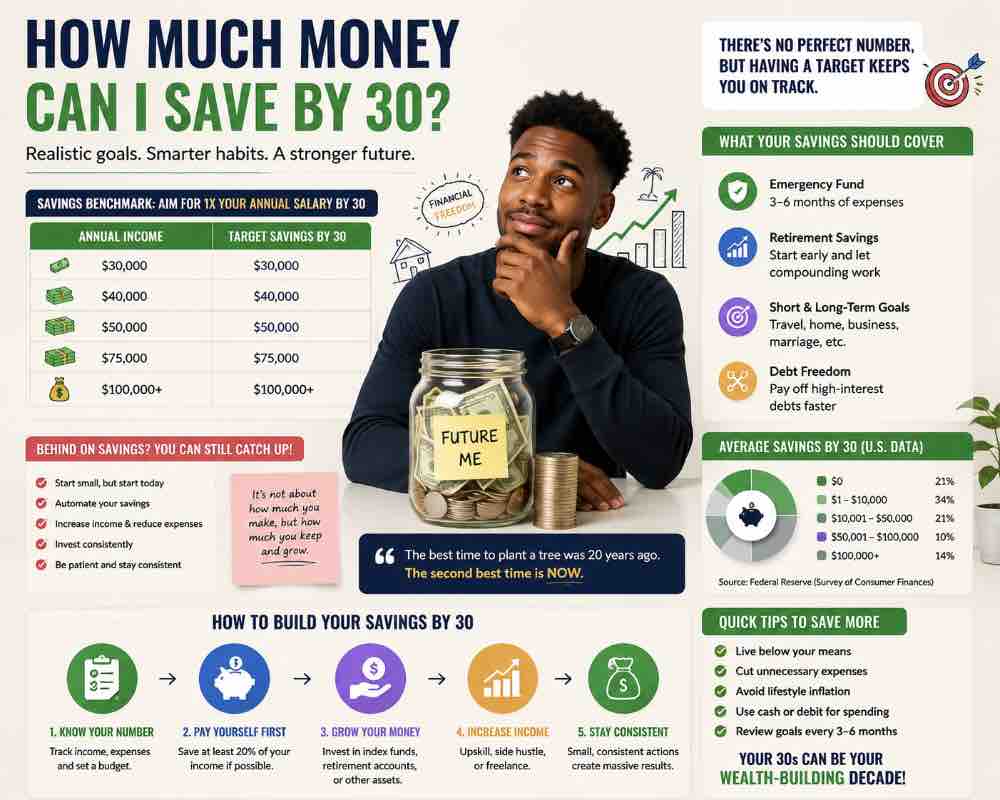
A commonly used guideline is to aim for about one year of your annual salary saved by age 30, although this is a target rather than a rule. For someone earning $50,000 a year, that would mean working toward $50,000 in savings and investments. But if you’re currently nowhere near that amount, it doesn’t mean you’ve failed financially.
What matters more is building consistent saving habits, creating an emergency fund, paying down expensive debt, and gradually increasing your savings as your income grows.
In this guide, we’ll break down how much money you should have saved by 30, realistic savings targets, how to calculate your personal goal, and practical ways to catch up if your savings are behind.
Is There a “Right” Amount to Have Saved by 30?
You may see financial guidelines suggesting that you should have the equivalent of one year’s salary saved by 30. For example, if you earn $50,000 a year, the benchmark would be around $50,000. But think of this as a long-term target, not a pass-or-fail test.
Someone earning $30,000 with $10,000 saved and no high-interest debt could potentially be in a healthier financial position than someone earning $100,000 with $5,000 saved and $40,000 in credit-card debt.
A More Useful Way to Measure Your Progress
Instead of obsessing over one number, look at whether you are building a solid financial foundation:
- Emergency savings: Aim for roughly 3–6 months of essential expenses.
- Retirement savings: Contribute consistently and increase contributions as your income grows.
- Debt: Prioritize expensive, high-interest debt.
- Monthly savings: Develop a habit of saving part of every paycheck.
- Financial flexibility: Have enough cash available to handle unexpected expenses without relying on credit cards or loans.
What If You’re Nowhere Near the Benchmark?
Don’t let an online savings benchmark convince you that you’re financially behind forever. Life doesn’t follow a spreadsheet.
If you have $2,000 saved at 30, for example, your next goal doesn’t have to be $50,000. You could focus on reaching $5,000, then $10,000, while simultaneously improving your income and reducing debt.
The most important question isn’t simply “How much should I have saved by 30?” It’s “Am I consistently moving toward a stronger financial position?”
If the answer is yes, you’re already heading in the right direction.
The Common Savings Benchmark for Your 30s
A commonly cited rule of thumb is to have around one year of your annual income saved by age 30. For example, if you earn $50,000 a year, a long-term target could be having roughly $50,000 saved across retirement accounts, investments, and other meaningful savings.
However, this should be treated as a guideline, not a financial deadline. Someone who graduated from university with student debt, started working later, supports family members, or lives in an expensive city may naturally have less saved than someone who started earning early with few financial obligations.
Your emergency fund should generally be reserved for genuine financial emergencies, such as:
- Unexpected medical or essential expenses
- Urgent car or home repairs
- Losing your job or main source of income
- Necessary travel because of a family emergency
A weekend getaway, new phone, or spontaneous shopping trip probably shouldn’t qualify just because your bank account is feeling adventurous.
Should I Prioritize Savings or Paying Off Debt?
If you’re trying to figure out how much money you should have saved by 30, you may face another important question: should you build your savings first or focus on paying off debt?
The honest answer is usually both—but not equally at the same time.
Start With a Small Emergency Fund
Before throwing every extra dollar at your debt, try to build a small emergency cushion. Even $500–$1,000 can help cover an unexpected repair, medical bill, or urgent expense without forcing you to reach for a credit card.
Once you have that basic safety net, you can become more aggressive with debt repayment.
A Simple Priority Order
For many people, a practical approach looks like this:
- Pay your essential bills and minimum debt payments.
- Build a starter emergency fund.
- Contribute enough to get any available employer retirement match.
- Attack high-interest debt aggressively.
- Build your emergency fund toward 3–6 months of essential expenses.
- Increase retirement and long-term savings as your debt decreases.
What If Your Debt Is Low-Interest?
Low-interest debt, such as some mortgages or student loans, can be a different situation. If the interest rate is relatively low, you may reasonably choose to balance extra debt payments with investing and saving for other goals.
How to Catch Up on Savings After 30
If you’ve reached 30 and your savings account looks more like a quiet parking lot than a financial safety net, take a breath. You’re not automatically behind, and there’s no financial police coming to confiscate your birthday cake.
The good news is that you can still make significant progress with the right strategy. The goal isn’t to suddenly save a huge amount of money overnight. Instead, focus on creating a sustainable system that allows you to save more consistently while dealing with your everyday expenses.
1. Find Out Where Your Money Is Going
Before trying to save more, look at where your money currently goes. Review your bank statements and categorize your spending into essentials, debt payments, savings, subscriptions, entertainment, eating out, and other expenses.
You may discover that several small expenses are quietly eating into your income every month.
2. Set a Realistic Savings Target
Don’t choose an unrealistic savings goal just because someone online claims they saved half their salary.
Start with a percentage you can actually maintain. If 10% of your income is manageable, begin there and increase it gradually as your income improves.
For example, if you earn $3,000 per month, saving 10% would give you $300 monthly. Increasing that to 15% would bring your monthly savings to $450.
3. Build an Emergency Fund
An emergency fund should be one of your priorities if you’re trying to catch up financially.
Start with a smaller target, such as $1,000 or one month of essential expenses, before working toward three to six months of expenses.
This money can help cover unexpected costs such as car repairs, urgent travel, household expenses, or a temporary loss of income without forcing you to rely on credit cards or loans.
4. Automate Your Savings
One of the easiest ways to become more consistent is to stop relying on willpower.
Set up an automatic transfer from your checking account to your savings account shortly after payday. Treat your savings contribution like another monthly bill.
Even if the amount is initially small, consistency matters.
5. Attack High-Interest Debt
Saving money while carrying expensive high-interest debt can be difficult. Credit card interest, payday loans, and other costly debts can grow faster than your savings.
Consider creating a plan to pay down high-interest debt while maintaining a basic emergency fund. Once expensive debt is under control, you can redirect more of your income toward savings and investing.
6. Look for Ways to Increase Your Income
Cutting expenses has limits. Increasing your income can give you more room to save.
Depending on your situation, you could consider negotiating your salary, changing jobs, freelancing, taking on additional work, selling unused items, or developing a skill that can increase your earning potential.
The key is to avoid automatically increasing your lifestyle every time your income rises.
7. Save Your Raises and Windfalls
When you receive a raise, bonus, tax refund, gift, or unexpected income, consider directing at least part of it toward your financial goals.
For example, instead of immediately spending a $2,000 bonus, you could put $1,000 into savings and use the remaining $1,000 for other priorities.
You still enjoy the money while making meaningful progress.
8. Take Advantage of Cashback and Discounts
Saving doesn’t always mean refusing to spend money. If you’re going to make a purchase anyway, cashback programs, coupons, loyalty rewards, and discounts can reduce the amount you actually pay.
The important rule to our guide on What is cashback is: don’t buy something just because it offers cashback.
A 5% cashback reward isn’t a bargain if you spent $100 on something you didn’t need.
9. Increase Your Savings Gradually
If you currently save $200 per month, you don’t necessarily need to jump straight to $1,000.
Try increasing your savings whenever your finances improve. You could move from $200 to $250, then $300, and continue increasing the amount over time.
Small increases can become significant when maintained for years.
10. Start Investing for Long-Term Goals
Once you have an appropriate emergency fund and a manageable debt situation, consider investing for long-term goals such as retirement.
The earlier you start, the more time your money has to potentially grow through compound returns. However, investments can lose value, so choose options that match your risk tolerance, goals, and time horizon.
11. Don’t Compare Your Savings to Other People
Someone else’s $50,000 savings balance doesn’t tell you their income, debt, family circumstances, inheritance, or financial history.
Instead of asking, “Why don’t I have as much as they do?”, ask:
“Am I in a better financial position than I was one year ago?”
That comparison is much more useful.
12. Give Yourself a Catch-Up Timeline
Instead of focusing only on a huge savings number, create milestones.
For example:
- First goal: Build a starter emergency fund.
- Second goal: Pay down high-interest debt.
- Third goal: Build several months of essential expenses.
- Fourth goal: Increase retirement and long-term investments.
- Fifth goal: Continue increasing your savings rate as your income grows.
Your financial comeback doesn’t have to happen in one year. What matters is having a plan and sticking with it.
How Much Should I Save Each Month?
If you’re wondering how much you should save each month, a good starting point is to aim for 10%–20% of your take-home income. But don’t treat that percentage like a financial law carved into stone. Your ideal savings rate depends on your income, expenses, debt, and financial goals.
Common Money Mistakes to Avoid in Your 30s
Your 30s can be an exciting financial chapter, but they can also be the decade when small money mistakes become expensive ones. You may be earning more than you did in your 20s, but higher income often comes with higher rent, bigger bills, family responsibilities, and lifestyle upgrades.
If you’re wondering how much money you should have saved by 30, don’t focus only on the number in your savings account. Your financial habits matter just as much. Here are some common mistakes worth avoiding.
1. Increasing Your Lifestyle Every Time Your Income Rises
Getting a raise feels great—until your new income somehow disappears just as quickly as your old one.
Instead of immediately upgrading your car, apartment, phone, or spending habits, consider directing part of every pay increase toward savings, investments, or debt repayment.
2. Having No Emergency Fund
Life has a funny way of sending unexpected bills exactly when your bank account is feeling confident.
An emergency fund can help cover expenses such as unexpected repairs, medical costs, or a temporary loss of income without forcing you to rely on expensive credit.
A good starting point is to build three to six months of essential living expenses, although your ideal amount depends on your circumstances.
3. Ignoring Retirement Savings
Your 30s may feel too early to worry seriously about retirement, but time is one of the biggest advantages you have when building long-term wealth.
Even if you can’t contribute a large amount right now, starting consistently and increasing your contributions as your income grows can make a significant difference over time.
4. Relying Too Much on Credit Cards
Credit cards aren’t automatically bad, but carrying expensive credit-card debt from month to month can seriously slow down your financial progress.
If you’re trying to build savings by 30 while also paying high interest on debt, consider creating a plan that tackles expensive debt alongside your savings goals.
5. Comparing Your Finances to Other People
Someone your age may own a house, drive a new car, travel frequently, or post pictures from expensive vacations. That doesn’t tell you what’s happening behind the scenes.
They could have substantial savings—or substantial debt.
Instead of asking, “Why don’t I have what they have?”, ask, “Am I making progress compared with where I was a year ago?”
6. Not Having Clear Financial Goals
Saving money without knowing what you’re saving for can make it surprisingly easy to spend it.
Give your money specific jobs. For example:
- Emergency fund
- Home deposit
- Retirement
- Education
- Travel
- Starting a business
- Paying off debt
Clear goals make it easier to decide what deserves your money and what doesn’t.
7. Waiting Until You Earn More to Start Saving
“I’ll start saving when I make more money” sounds reasonable—but there’s always another expense waiting around the corner.
Start with what you can afford, even if it’s a small amount. You can increase your savings rate when your income improves.
8. Forgetting to Protect Your Future Income
Building savings is important, but protecting your finances matters too. Depending on your situation, this could mean having appropriate insurance, maintaining an emergency fund, keeping important documents organized, and avoiding unnecessary financial risks.
9. Keeping All Your Money in One Place
Your everyday spending money, emergency savings, and long-term investments don’t necessarily need to sit in the same account.
Separating your money according to its purpose can make your finances easier to manage and reduce the temptation to spend money you’ve actually set aside for the future.
10. Thinking You’re Already Too Far Behind
Perhaps the biggest mistake is believing that because you haven’t reached a particular savings target by 30, there’s no point trying.
There isn’t a universal deadline for becoming financially secure. Your starting point matters less than the steps you take next.
Frequently Asked Questions About Saving by 30
How much money should I have saved by 30?
A commonly used benchmark is to have around one year of your annual income saved or invested by age 30. However, this isn’t a strict requirement. Your income, expenses, debt, location, and financial responsibilities all affect what a realistic savings target looks like.
Is $10,000 enough savings at 30?
Having $10,000 saved at 30 can be a solid starting point, particularly if you’re also contributing regularly to retirement or investments and don’t have significant high-interest debt. The more important thing is having a plan to keep increasing your savings.
What if I have nothing saved by 30?
Don’t panic. Being 30 with little or no savings doesn’t mean you’re financially doomed. Start by building a small emergency fund, reducing unnecessary expenses, paying down high-interest debt, and setting up an automatic monthly savings contribution.
How much should I save every month in my 30s?
A popular target is 15% of your income for retirement, although your ideal percentage depends on your income, existing savings, retirement goals, and employer contributions. If 15% isn’t realistic right now, start with an amount you can maintain and increase it gradually.
How much should I have in an emergency fund by 30?
A reasonable goal is to have 3–6 months of essential living expenses in an easily accessible emergency fund. If your income is unpredictable or you have significant financial responsibilities, having closer to six months or more may provide additional protection.
Should I save for retirement or pay off debt first?
It depends on the type of debt. High-interest debt, such as expensive credit-card balances, should generally be a priority. At the same time, don’t necessarily ignore retirement completely—especially if your employer offers a contribution match.
Is retirement savings included in my savings goal?
It can be. When discussing long-term savings benchmarks, people often include retirement accounts and investments rather than counting only the cash sitting in a savings account. However, your emergency fund should remain separate and easily accessible.
Is it too late to start saving at 30?
Absolutely not. Starting at 30 still gives you decades to save and invest for the future. The key is to stop worrying about where you should have been and start focusing on what you can consistently do from today onward.
How can I catch up if I’m behind on savings?
Start by calculating your monthly income and essential expenses. Then look for expenses you can reduce, increase your savings rate when your income rises, automate transfers to savings, tackle high-interest debt, and consider ways to increase your income.
Should I prioritize buying a house or building savings?
Before making a major purchase such as a home, it’s generally wise to have an emergency fund and a sustainable budget. A house shouldn’t leave you with no cash available for unexpected repairs, job loss, or other emergencies.
What is more important: income or savings rate?
Both matter, but your savings rate is something you can directly work on. Increasing your income while allowing your lifestyle expenses to rise just as quickly may not improve your financial position. Ideally, increase your income while directing part of every raise toward savings and investments.
What is the biggest savings mistake people make in their 30s?
One common mistake is waiting for the “perfect” time to start. It’s easy to think you’ll save more after getting a better job, paying off a loan, or earning more money. Starting with a manageable amount today can be much more productive than constantly waiting for tomorrow.
Final Thoughts: How Much Should I Have Saved by 30?
So, how much money should you have saved by 30? The honest answer is there isn’t one number that works for everyone. While benchmarks such as having around one year of your income saved can give you a useful target, your financial situation is unique.
If you’re already ahead, keep building. If you’re behind, don’t let a savings benchmark convince you that you’ve failed. What matters most is what you do next.
Start with an emergency fund, pay attention to high-interest debt, contribute consistently toward retirement, and look for opportunities to increase your savings rate as your income grows. Even small improvements can make a meaningful difference over time.
Most importantly, don’t compare your bank account to someone else’s highlight reel. Your goal isn’t to win a savings competition by 30—it’s to build a financial life that gives you more stability, flexibility, and freedom as you get older.