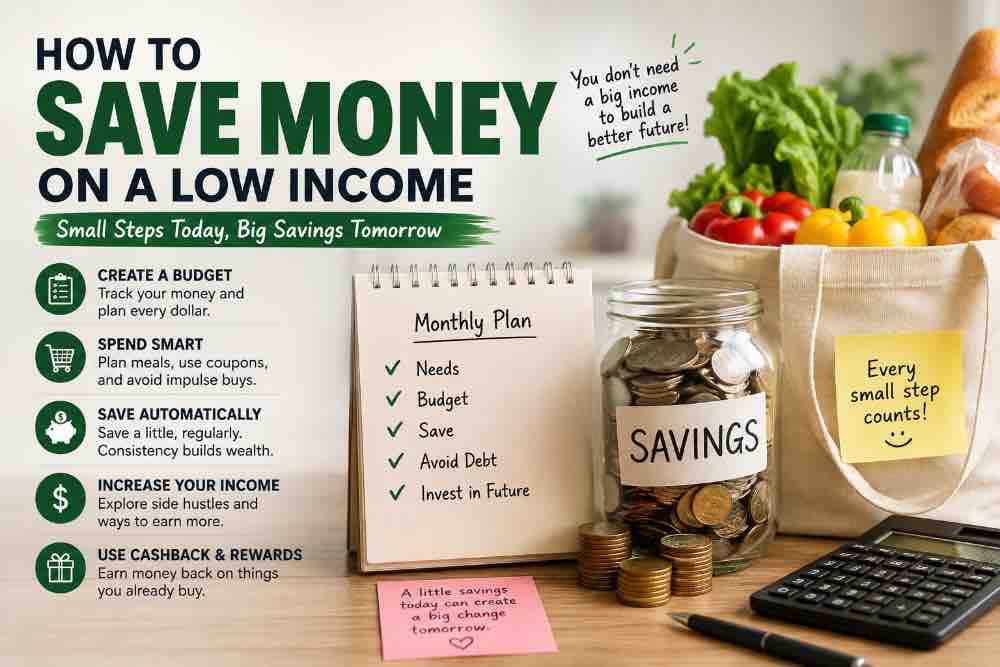
Saving money on a low income can feel like trying to fill a swimming pool with a teaspoon. You get paid, pay the bills, buy groceries, handle transportation, and suddenly your bank account is staring back at you like, “That’s it?”
But saving money isn’t only for people with six-figure salaries and refrigerators full of organic avocado. Even on a tight income, you can build savings by making small, realistic changes that actually fit your life.
The secret isn’t necessarily earning more overnight—it’s learning how to keep more of what you already earn. From cutting sneaky expenses and creating a simple budget to using cashback, discounts, and automatic savings, there are practical ways to make your money stretch further.
If your goal is to save money fast on a low income, this guide will show you where to start, what expenses to tackle first, and how to build savings without feeling like you’ve been sentenced to a lifetime of eating noodles.
Because every small amount saved today can become a financial cushion tomorrow—and your future self will definitely appreciate it.
What Does Low Income Mean?
A low income is an income that leaves you with little disposable money after covering essential living expenses such as housing, food, transportation, utilities, healthcare, and debt.
There isn’t one universal income number that defines “low income.” It depends on factors such as:
- Where you live — $2,000 a month means something different in Nigeria, the UK, or the US.
- Household size — supporting a family on the same income is very different from supporting yourself.
- Cost of living — rent, food, transportation, and utilities can consume a large portion of income.
- Debt and financial obligations — loan repayments can significantly reduce disposable income.
- Income stability — irregular or seasonal earnings can make saving difficult even when annual income looks reasonable.
What Mistakes Should People Avoid When Trying to Save Money Quickly?
Saving money quickly sounds great until you try to do it on a tight income. The biggest mistake is thinking you need to completely change your lifestyle overnight. That usually creates a budget so restrictive that you abandon it after a few weeks.
Instead, focus on sustainable changes that free up money without making your everyday life miserable.
Setting an Unrealistic Savings Target
If you earn a modest income and decide you’re going to save 30% of your paycheck immediately, you may be setting yourself up for failure.
Start with an amount you can consistently afford—even if that’s $5, $10, or $20 per week. Once the habit becomes comfortable, increase it.
Cutting Every Enjoyment From Your Budget
A budget that allows nothing but bills and basic necessities can quickly become exhausting.
You don’t need to eliminate every restaurant meal, hobby, or occasional treat. Give yourself a reasonable amount for enjoyment and spend it intentionally.
Using Credit to “Save” Money
This is one of the biggest traps.
If you’re putting $200 into savings while simultaneously adding $300 to a credit-card balance, you’re not really getting ahead. You’re simply moving money from one place to another while potentially accumulating interest.
Pay attention to your overall financial position, not just your savings balance. Learn how to apply for a budgeting advance universal credit online.
Buying Things Because They’re on Sale
A discount isn’t automatically a saving.
If you spend $80 on something you didn’t need because it was marked down from $120, you’ve still spent $80.
The better question is:
“Would I have bought this if there were no discount?”
If the answer is no, keeping the money is probably the better deal.
Treating Cashback as Free Money
What is Cashback? Cashback can be useful, especially for purchases you’re already planning to make. But spending extra just to earn cashback defeats the purpose.
For example, buying a $100 item you don’t need to receive $5 cashback isn’t saving $5. You’re still $95 poorer.
Use cashback as a way to reduce the cost of planned purchases, not as a reason to shop.
Forgetting Irregular Expenses
A budget can look perfect until an annual insurance bill, school expense, car repair, birthday, or holiday arrives.
Set aside a small amount regularly for expenses that don’t happen every month. This prevents unexpected bills from destroying your savings progress.
Trying to Save Without Tracking Spending
You can’t fix spending leaks you don’t know exist.
Track your expenses for at least a couple of weeks. You may discover that several seemingly harmless purchases are consuming a surprisingly large amount of money each month.
Giving Up After One Bad Month
Nobody follows a budget perfectly.
You might overspend one month, have an unexpected expense, or save less than planned. That doesn’t mean the system has failed.
Review what happened, make adjustments, and start again.
12 Steps On How To Save Money Fast On A Low Income

If you want to save money on a low income, the goal shouldn’t be to stop spending altogether. It should be to make sure a small amount of your income consistently survives until the end of the month.
Here’s what you should do:
- Track every expense for at least 30 days so you know where your money is actually going.
- Create a realistic budget based on your real income—not an ideal income.
- Save immediately after getting paid, even if it’s only 1–5% of your income.
- Start with a small emergency fund, such as your first $100 or the equivalent in your local currency.
- Cut recurring expenses you don’t genuinely need, especially subscriptions and unnecessary fees.
- Plan your groceries and compare prices before buying.
- Avoid impulse purchases by giving yourself a 24-hour waiting period for non-essential items.
- Use cashback, coupons, discounts, and loyalty rewards only on purchases you were already planning to make.
- Find ways to increase your income if you’ve already cut your expenses as much as reasonably possible.
- Give yourself a weekly spending limit so you don’t accidentally spend your monthly budget in the first two weeks.
- Keep savings separate from everyday spending money so you’re less tempted to dip into it.
- Increase your savings gradually whenever your income rises or you eliminate an expense.
The biggest mindset shift is this: don’t wait until you have “extra” money to save. Decide on a small amount you can afford and treat saving as one of your regular expenses.
Even saving a small amount consistently can eventually give you something extremely valuable when you’re on a low income: financial breathing room.
How to Save Your First $100, $500, or $1,000
Saving your first $100 can feel surprisingly difficult when money is tight. But once you reach that first milestone, something important changes: you prove to yourself that you can actually keep money instead of watching every paycheck disappear.
If you’re on a low income, don’t worry about hitting $1,000 immediately. Build the savings habit in stages.
Start With Your First $100
Your first $100 should be about creating momentum, not perfection.
Try setting a small weekly target:
- Save $10 a week → $100 in 10 weeks
- Save $20 a week → $100 in 5 weeks
- Save $25 a week → $100 in 4 weeks
Look for temporary ways to accelerate the goal, such as canceling an unused subscription, cooking at home, selling something you no longer use, or putting cashback and rewards directly into savings.
The important rule is simple: once the money reaches $100, don’t immediately spend it just because you’ve reached the goal.
How to Reach $500
Once you’ve saved your first $100, aim for the next $400.
At this stage, consistency becomes more important than finding dramatic ways to cut expenses.
You could save:
- $25 per week → $500 in 20 weeks
- $50 per week → $500 in 10 weeks
- $100 per month → $500 in 5 months
Consider creating a separate savings account so the money isn’t sitting beside your everyday spending money.
You can also direct unexpected money toward the goal, including:
- Tax refunds
- Bonuses
- Gifts
- Side-income
- Money from selling unused items
- Cashback
- Rebates
- Expense reductions
How to Save Your First $1,000
Your first $1,000 can become a small emergency fund that gives you some breathing room when life inevitably decides to send an unexpected bill.
If you can save $100 per month, you’ll reach $1,000 in 10 months.
At $200 per month, you’ll get there in 5 months.
At $25 per week, it will take about 40 weeks.
Don’t compare your timeline with someone else’s. If you’re working with a limited income, slow progress is still progress.
Use the $100 → $500 → $1,000 Method
Instead of staring at a $1,000 target and wondering where on earth you’re supposed to find it, break it into three milestones:
$100: Build the habit.
$500: Create a meaningful financial cushion.
$1,000: Establish a stronger emergency fund.
Every milestone gives you a reason to keep going.
Make Saving Automatic
One of the easiest ways to save is to move the money before you have an opportunity to spend it.
For example, if you receive $500 and immediately move $20 into savings, you now have $480 available for your planned spending.
It may only be $20, but repeated every payday, those small transfers can add up surprisingly quickly.
What If Someone Genuinely Cannot Cut Any More Expenses?
Sometimes, the problem isn’t that you’re spending too much. Your income simply isn’t enough to comfortably cover everything you need. And that’s an important distinction.
If you’ve already cut unnecessary subscriptions, reduced takeout, compared bills, planned your groceries, and stopped impulse purchases, telling you to “just cut more” isn’t helpful. You can’t budget your way out of a mathematical problem when your essential expenses are already higher than your income.
At that point, focus on increasing the gap between your income and essential expenses rather than squeezing another $5 out of your budget.
Look for ways to increase your income
Even a relatively small increase can make saving possible.
Depending on your circumstances, consider:
- Picking up overtime or additional shifts
- Freelancing with a skill you already have
- Selling unused clothes, electronics, or household items
- Offering local services such as cleaning, tutoring, delivery, or repairs
- Taking temporary or weekend work
- Asking for a raise or looking for a better-paying position
- Turning a hobby or skill into a small side business
For example, if your budget leaves you with only $20 at the end of the month, finding an extra $100 of income could completely change your ability to save.
How To Save Money on Groceries Without Making Life Miserable?
Saving money on groceries doesn’t mean surviving on plain rice while staring sadly at pictures of pizza. The goal is to spend less without making every meal feel like a punishment.
The best approach is to reduce waste, plan better, and spend your money on foods you actually enjoy.
Plan Your Meals Before You Shop
You don’t need a complicated meal-prep spreadsheet. Simply decide what you’re likely to eat for the next few days and shop around those meals.
For example, you might plan:
- Rice and chicken
- Pasta with vegetables
- Beans and plantain
- Eggs and toast
- Homemade sandwiches
- One flexible “use what you have” meal
Planning reduces the temptation to order takeout because you suddenly realize there’s “nothing to eat” despite having a kitchen full of food.
Shop With a List
A shopping list gives your wallet some protection.
Before leaving home, check what you already have in your fridge, freezer, and cupboards. Then write down what you actually need.
Try not to turn the grocery store into an audition for every snack you’ve ever wanted.
Buy Cheaper Alternatives
You don’t necessarily have to buy the cheapest product available. Instead, compare similar products and look for good-value alternatives.
Store brands, generic products, larger packages, and local alternatives can sometimes cost less than heavily marketed brands.
But don’t automatically buy in bulk. A larger package is only cheaper if you’re actually going to use it before it expires.
Reduce Food Waste
One of the easiest ways to save money is to stop throwing money in the bin—literally.
Use leftovers creatively. Extra chicken can become sandwiches or wraps. Leftover vegetables can go into rice, pasta, omelets, or soup.
Also, organize your fridge so foods that need to be eaten soon are easy to see.
Don’t Eliminate Everything You Enjoy
This is where many budgets fail.
If you love chocolate, snacks, or your favorite breakfast cereal, completely banning them may make your grocery budget miserable and difficult to maintain.
Instead, budget for a few things you genuinely enjoy.
Saving money should make your finances healthier—not make you hate your life.
Compare Prices and Use Rewards
Before buying something you regularly purchase, compare prices between stores or brands when practical.
You can also take advantage of legitimate:
- Store loyalty programs
- Coupons
- Cashback offers
- Promotional discounts
- Multi-buy deals you would have purchased anyway
The key phrase is “you would have purchased anyway.”
If a $10 cashback offer convinces you to spend $60 on something you didn’t need, you haven’t saved $10—you’ve spent $50 unnecessarily.
Give Yourself a Grocery Budget
Choose and tea from our realistic $500 weekly or monthly budget grocery limit based on your income and household needs.
Then divide it into smaller amounts if that makes it easier to control. For example, a $400 monthly food budget could become roughly $100 per week.
Don’t worry if you don’t hit the target perfectly every week. The goal is to understand your spending and gradually improve it.
Frequently Asked Questions About Saving Money Fast on a Low Income
How much should I save if I have a low income?
There is no universal amount that works for everyone. If money is extremely tight, start with whatever is realistic—even $5, $10, or $20 per week. The goal is to build the habit while gradually increasing the amount as your finances improve.
How can I save money when my income barely covers my bills?
Start by tracking your spending and separating essential expenses from discretionary spending. Look for recurring costs you can reduce, such as subscriptions, takeout, unnecessary fees, and expensive alternatives.
What is the easiest way to start saving money?
Automating a small amount immediately after payday is one of the simplest approaches. Even a small automatic transfer can help you save before the money gets absorbed into everyday spending.
Should I save money or pay off debt first?
It depends on the type and cost of the debt. In many cases, it’s sensible to build a small emergency cushion while aggressively paying down expensive debt.
Knowing how much I should have saved by 30 and Having some emergency savings to it can prevent an unexpected expense from forcing you to borrow again.
How can I stop spending money impulsively?
Create a waiting period before non-essential purchases. For example, wait 24 hours before buying something you didn’t plan for.
You can also remove saved payment details from shopping websites, unsubscribe from promotional emails, and create a separate spending allowance for non-essential purchases.
How can I save money without feeling deprived?
Don’t try to eliminate everything enjoyable. Instead, identify the expenses that genuinely make you happy and keep them within your budget while cutting spending that doesn’t provide much value.
Is it possible to save money on minimum wage?
Yes, although the amount may be small and progress may be slower. Start with a realistic target and focus on consistency.
If your essential expenses already consume almost all your income, increasing your income may have a bigger impact than trying to cut another few dollars from your budget.
What should I do if I fail to save one month?
Don’t treat one bad month as a failed financial plan. Unexpected expenses happen.
Review what caused the setback, adjust your budget, and start again with your next paycheck. Consistency over the long term matters more than having a perfect month every month.