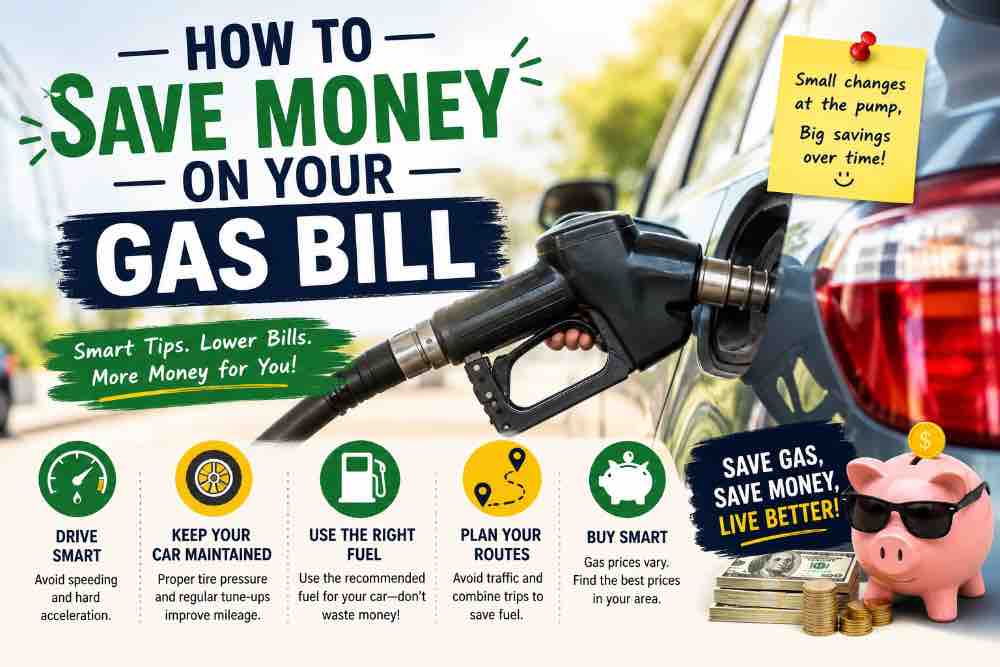
Gas prices have a funny way of reminding you that your car has expensive hobbies.
You fill up the tank, watch the numbers climb, and suddenly you’re wondering whether walking everywhere is actually that bad. The good news? You don’t necessarily need to drive less or buy a new car to save money on gas.
Small changes to how you drive, where you fill up, how you maintain your car, and how you plan your trips can make a noticeable difference. And when fuel prices keep creeping upward, every saved dollar—or pound, depending on where you live—is money that can stay in your bank account.
In this guide, we’ll look at practical ways on how to save money on gas without making your daily life miserable.
Note: If you’re trying to reduce your overall expenses, saving at the pump is only one piece of the puzzle. Check out our guide on how to save money fast on a low income for practical ways to cut everyday costs without making your life miserable.
How to Save Money on Gas: 15 Easy Ways to Cut Your Fuel Costs
1. Drive More Smoothly
Your gas pedal isn’t a light switch.
Constantly accelerating hard, braking suddenly, and speeding up again can increase fuel consumption. Instead, try to accelerate gradually and maintain a steady speed whenever traffic conditions allow.
Smooth driving is easier on your car and your wallet.
Your passengers may also appreciate not feeling like they’re auditioning for a racing movie.
2. Avoid Unnecessary Idling
Leaving your engine running while you’re parked wastes fuel.
If you’re sitting outside a store, waiting for someone, or scrolling through your phone in a parking lot, ask yourself whether the engine really needs to be running.
A few minutes may not seem like much, but repeated every day, those little fuel losses can add up.
3. Keep Your Tires Properly Inflated
Underinflated tires can increase rolling resistance, which means your engine has to work harder to move the vehicle.
Check your tire pressure regularly and keep it at the level recommended by your vehicle manufacturer.
Don’t guess based on how the tire looks. Tires can be underinflated without looking obviously flat.
4. Don’t Carry Extra Weight
Your car doesn’t need to become a storage unit.
Remove unnecessary heavy items from the trunk and back seat. While one forgotten bag probably won’t destroy your fuel economy, carrying lots of unnecessary weight around all the time can make your vehicle work harder.
If your car is currently transporting three bags of clothes, a toolbox, old textbooks and something you haven’t identified since 2022, it might be time for a clean-out.
5. Combine Your Errands
Instead of making five separate trips, try grouping your errands together.
For example, you could:
- Buy groceries after work
- Pick up your prescription on the same trip
- Stop at the bank while you’re already nearby
- Visit several stores in the same area
Fewer unnecessary journeys generally mean less fuel consumed.
6. Compare Gas Prices Before Filling Up
The gas station you always use isn’t necessarily the cheapest one.
Before filling your tank, check prices at nearby stations. A small difference per litre or gallon can become significant over months of regular driving.
However, don’t drive 20 minutes out of your way to save a tiny amount of money. If you burn half the fuel you intended to save getting there, congratulations—you’ve played yourself.
7. Use a Fuel-Price App
Fuel-price apps and local price websites can help you find cheaper gas stations nearby.
Depending on where you live, available tools may show current or recently reported fuel prices, helping you decide where to stop.
The key is to compare prices before your fuel light turns on. Desperation is rarely a good negotiating position.
8. Don’t Always Choose the Most Convenient Station
Convenience often comes with a price.
Gas stations located directly beside major highways, busy intersections, airports, or tourist areas may charge more than stations a short distance away.
If you’re already driving through the area, checking nearby alternatives can help you avoid paying extra simply because the station was the first one you saw.
9. Maintain Your Car Regularly
A poorly maintained vehicle can waste fuel.
Keep up with your manufacturer’s recommended maintenance, including:
- Oil and filter changes when required
- Air filter inspections or replacement
- Tire-pressure checks
- Spark plug maintenance where applicable
- Regular inspections
- Addressing warning lights promptly
Don’t ignore a small mechanical problem until it becomes a large—and expensive—mechanical problem.
10. Use Cruise Control When Appropriate
On suitable roads, cruise control can help you maintain a consistent speed instead of constantly speeding up and slowing down.
It’s particularly useful on long, relatively flat stretches of road.
However, don’t use it blindly. In heavy traffic, poor weather, steep terrain, or situations requiring frequent speed changes, controlling the vehicle manually may be more appropriate.
11. Avoid Aggressive Acceleration and Braking
Repeated hard acceleration followed by heavy braking is one of the easiest ways to turn fuel into wasted money.
Look farther ahead when driving and anticipate traffic changes where possible.
If you see traffic slowing down ahead, gradually reduce your speed rather than waiting until the last second and slamming on the brakes.
Your brake pads and your fuel budget may both thank you.
12. Reduce Unnecessary Air Conditioning Use
Air conditioning requires energy, which can affect fuel consumption.
That doesn’t mean you need to drive around sweating like you’re training for a marathon. Use your AC sensibly and avoid leaving it running unnecessarily when you’re parked.
When conditions allow, ventilation or opening the windows can sometimes be an alternative, although at higher road speeds the aerodynamic effect of open windows can offset some of the benefit.
Comfort matters too. Saving a tiny amount of fuel isn’t worth turning your car into a mobile sauna.
13. Plan Your Route Before Driving
Getting lost is expensive.
Use navigation to find an efficient route, check traffic conditions when possible, and avoid unnecessary detours.
If two routes take roughly the same amount of time, a route with fewer stops and smoother traffic may sometimes use less fuel.
Planning ahead can also help you combine multiple errands into one trip.
14. Consider Carpooling
If you regularly travel the same route as coworkers, classmates, friends, or family members, sharing rides can reduce the amount of fuel each person pays for.
For example, if four people normally drive separate cars to the same destination, sharing one or two vehicles could significantly reduce total fuel consumption.
Just establish the rules beforehand—especially who drives and how fuel costs are divided. Saving money shouldn’t require a friendship-ending spreadsheet.
15. Track Your Fuel Spending
You can’t improve what you don’t measure.
For one month, record:
- How much you spend on gas
- How often you fill up
- How many miles or kilometres you drive
- Your approximate fuel economy
- Where you normally buy fuel
Once you know where your money is going, you can identify opportunities to cut costs.
For example, you might discover that your biggest problem isn’t the price of gas at all—it’s making multiple unnecessary trips every week.
✋Another way to reduce the cost of everyday purchases is by using cashback programs. Our cashback guide explains how cashback works and how you can earn money back when shopping.
How Much Can You Actually Save on Gas?
The amount depends on your vehicle, driving habits, fuel prices, mileage, and how much you drive.
Fuel costs can easily sneak into your monthly budget, especially if you commute regularly. Learning how to make a budget can help you see exactly how much you’re spending on transportation and where you can cut back.
Someone commuting 10 miles a week won’t have the same savings potential as someone driving 50 miles every day.
A useful approach is to combine several small improvements instead of looking for one magical trick.
For example:
Better route planning + fewer unnecessary trips + properly inflated tires + smoother driving + cheaper fuel stations = potentially meaningful savings over time.
The goal isn’t to become obsessed with squeezing every last drop of fuel out of your tank. It’s to stop wasting money where you don’t need to.
Simple Gas-Saving Habits to Start Today
If you want the easiest starting point, focus on these five habits:
- Check your tire pressure.
- Combine errands.
- Compare nearby gas prices.
- Avoid unnecessary idling.
- Accelerate and brake more smoothly.
None requires a fancy gadget or a complete lifestyle transformation.
Final Thoughts On How To Save Money On Gas Bills
Learning how to save money on gas isn’t about driving everywhere at 30 mph while praying for a tailwind.
It’s about making smarter decisions consistently.
Compare fuel prices, maintain your vehicle, plan your trips, drive smoothly, and avoid unnecessary journeys. Individually, these habits may seem small. Together, they can help reduce how much of your paycheck disappears into the fuel tank.
And let’s be honest: the less money your car demands from you, the more money you have for things that don’t have an engine light.