Picture this: your bank account has become so empty it’s echoing. You’ve checked under the sofa cushions, searched every jacket pocket, and even stared at your online banking app long enough, hoping the numbers would magically multiply out of pity. Unfortunately, your balance remains as stubborn as a cat refusing to take a bath.
If you’re waiting for your first Universal Credit payment, those first few weeks can feel like they’re moving in slow motion. Bills don’t wait, your stomach certainly doesn’t wait, and somehow your fridge has transformed into a museum displaying nothing but ketchup, half a lemon, and a mysterious container you’re too afraid to open.
That’s where a Budgeting Advance can come to the rescue. Think of it as a helping hand rather than a lottery win. It’s designed to help with essential expenses when life decides to throw unexpected costs your way—whether that’s replacing a broken washing machine, buying furniture for a new home, or covering other necessary household expenses.
In this guide, we’ll explain exactly how to apply for a Budgeting Advance Universal Credit, who qualifies, how much you may be able to borrow, and what happens after your application. We’ll skip the confusing government jargon, keep things simple, and maybe even squeeze in a smile or two along the way—because understanding your finances shouldn’t feel harder than assembling flat-pack furniture without the instructions.
What Is a Budgeting Advance?
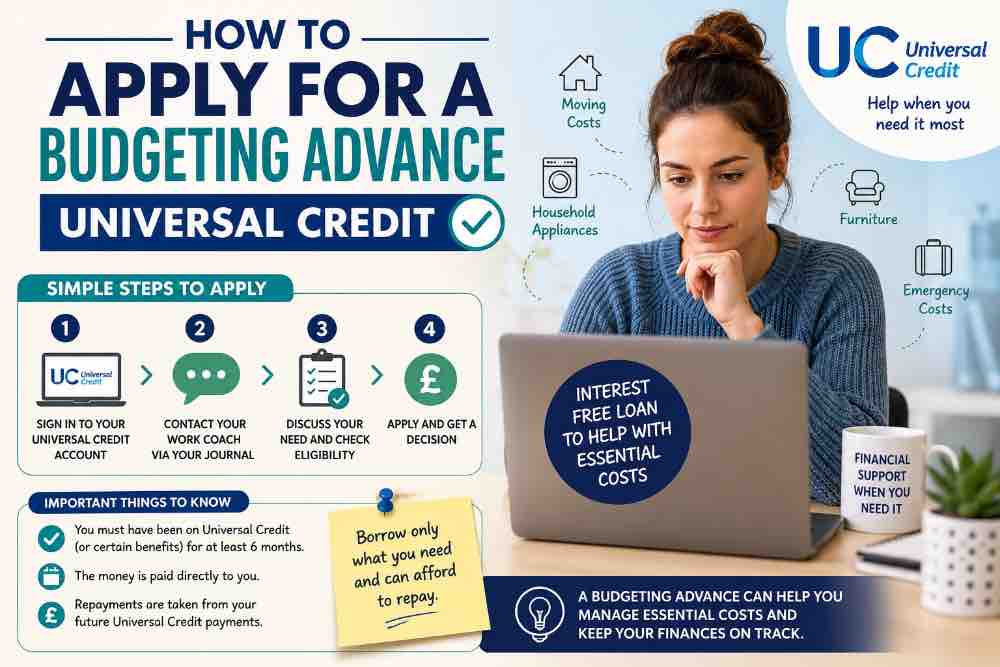
A Budgeting Advance is an interest-free loan available to eligible people receiving Universal Credit. It is designed to help cover essential one-off expenses that you may not be able to afford upfront. Unlike a grant, the money must be repaid, but repayments are automatically deducted from your future Universal Credit payments over an agreed period.
How Does a Budgeting Advance Work?
The aim is to provide temporary financial support when you face necessary costs that you can’t afford upfront, such as buying furniture, replacing a broken appliance, paying for work-related expenses, or covering moving costs.
Here’s how the process works:
1. Check Your Eligibility
Before applying, the Department for Work and Pensions (DWP) checks whether you meet the eligibility requirements. This includes factors such as:
- How long you’ve been receiving Universal Credit.
- Your earnings (if you’re working).
- Whether you still owe money from previous Budgeting Advances or other benefit advances.
2. Submit Your Application
You can apply by:
- Logging into your Universal Credit online account and sending a journal message.
- Calling the Universal Credit helpline.
- Speaking with your work coach during an appointment.
During the application, you’ll be asked why you need the advance and how much you require.
3. The DWP Reviews Your Request
The DWP assesses whether:
- The expense is considered essential.
- You’re eligible under the current rules.
- You can reasonably afford the repayments without causing financial hardship.
They may ask for additional information before making a decision.
4. Receive the Money
If your application is approved, the Budgeting Advance is usually paid directly into your bank account. In many cases, payment arrives within a few working days, although timing can vary depending on your circumstances.
5. Repay the Advance
Repayments are automatically deducted from your future Universal Credit payments. Since the loan is interest-free, you’ll only repay the amount you borrowed—there are no extra fees or interest charges.
The repayment amount is spread over an agreed period, making it easier to manage alongside your regular living expenses.
Who Can Apply for a Budgeting Advance?
A Budgeting Advance is available to many people receiving Universal Credit, but not everyone will qualify. The Department for Work and Pensions (DWP) has specific eligibility rules that you must meet before your application can be approved.
Generally, you can apply if you:
- Receive Universal Credit and have been claiming it for at least six months. However, this six-month rule may not apply if you need the money to start a new job or stay in work.
- Need financial help for an essential one-off expense, such as furniture, household appliances, moving costs, clothing, or home repairs.
- Have earned less than £2,600 in the previous six months if you’re single, or less than £3,600 if you’re part of a couple.
- Do not already have an unpaid Budgeting Advance. In most cases, you can only have one Budgeting Advance outstanding at a time.
Who Cannot Apply?
You may not be eligible if:
- You’ve earned more than the income limit during the past six months.
- You’re still repaying a previous Budgeting Advance.
- You don’t receive Universal Credit or don’t meet one of the qualifying exceptions.
Eligibility Requirements for a Budgeting Advance Universal Credit
The Department for Work and Pensions (DWP) has specific eligibility rules to ensure the loan is provided to claimants who genuinely need help with essential one-off expenses.
To be eligible, you generally must meet the following requirements:
1. You Must Have Been Receiving Universal Credit for at Least Six Months
In most cases, you need to have been continuously receiving Universal Credit for six months or more before you can apply.
Exception: If you need the advance to help you start a new job or stay in work—for example, to buy work clothes, tools, or travel—you may be able to apply even if you have not been on Universal Credit for six months.
2. Your Earnings Must Be Below the Income Limit
Your earnings during the previous six months must not exceed:
- £2,600 if you’re single.
- £3,600 if you’re part of a couple.
These limits apply regardless of whether you have children.
3. You Cannot Already Owe Another Budgeting Advance
You can only have one Budgeting Advance outstanding at a time. If you’re still repaying a previous Budgeting Advance, you’ll usually need to clear that balance before applying for another one.
4. You Must Need the Money for an Eligible One-Off Expense
Budgeting Advances are intended for essential costs such as:
- Buying furniture or household appliances.
- Paying a tenancy deposit or moving costs.
- Purchasing essential clothing or footwear.
- Home repairs or improving home security.
- Funeral expenses.
- Essential items needed to start or remain in work.
They are not designed to cover everyday living expenses like groceries, utility bills, rent, or debt repayments.
5. The Minimum Loan Amount Is £100
The smallest Budgeting Advance you can request is £100. The amount you’re offered depends on your circumstances, your ability to repay, and the maximum available for your household.
How to Apply for a Budgeting Advance Universal Credit
You can apply online, through your work coach, or by contacting the Universal Credit helpline. The Department for Work and Pensions (DWP) will review your application and decide whether to offer you an interest-free advance based on your circumstances.

Follow these simple steps:
1. Check That You’re Eligible
Before applying, make sure you qualify. In most cases, you must:
- Have been receiving Universal Credit (or another qualifying benefit) for at least 6 months, unless the advance is to help you start or stay in work.
- Need help paying for an essential one-off expense.
- Be below the earnings limit for the previous six months.
- Not already owe an unpaid Budgeting Advance.
2. Decide What You Need the Advance For
A Budgeting Advance is intended for essential, unexpected costs, such as:
- Furniture or household appliances
- Clothing or footwear
- Home repairs
- Funeral expenses
- Rent deposit or moving costs
- Essential family items
It cannot be used for everyday living expenses like food, rent, utility bills, or debt repayments.
3. Apply Using Your Preferred Method
You can submit your application in one of three ways:
- Online: Log in to your Universal Credit account and send a message through your journal requesting a Budgeting Advance.
- Speak to Your Work Coach: If you have a scheduled Jobcentre appointment, ask your work coach to help you apply.
- Call the Universal Credit Helpline: If you prefer speaking to someone directly, you can apply over the phone.
4. Explain Why You Need the Money
During your application, you’ll need to explain:
- What you need the money for.
- Why the expense is necessary.
- How much you need to borrow.
Being honest and providing clear details can help the DWP assess your request more quickly.
5. Provide Any Required Information
The DWP may ask for:
- Proof of identity (if needed)
- Your bank account details
- Information about your income or savings
- Details about the item or expense you’re paying for
They may also ask follow-up questions before making a decision.
6. Wait for the Decision
Many applications are processed quickly, although the exact timeframe depends on your circumstances. If approved, you’ll be told:
- How much you’ll receive.
- How the money will be paid.
- How much will be deducted from your future Universal Credit payments to repay the advance.
How and When You’ll Receive the Money
If your Budgeting Advance application is approved, the money is usually paid directly into the same bank, building society, or credit union account where you receive your Universal Credit payments.
In many cases, you’ll receive the funds within a few working days after your application is approved. However, the exact timing can vary depending on your circumstances, when your application is processed, and whether any additional checks are needed. If your situation is particularly urgent, let the Department for Work and Pensions (DWP) know when you apply, as they may be able to prioritize your request in certain circumstances.
Once the payment has been sent, you’ll normally receive a notification through your Universal Credit online account or be informed by your work coach. Be sure to keep an eye on your journal for updates, as this is where the DWP often communicates decisions and payment information.
What to Do If Your Application Is Rejected
Having your Budgeting Advance application rejected can be frustrating, especially if you were counting on the money to cover an essential expense.
However, a rejection doesn’t always mean you’re out of options. Understanding why your application was declined can help you decide what to do next.
1. Find Out Why Your Application Was Refused
The first step is to ask for the reason behind the decision if it wasn’t made clear. Common reasons include:
- You haven’t been receiving Universal Credit for long enough.
- Your earnings exceeded the allowed limit.
- You already owe too much on previous Budgeting Advances.
- The expense doesn’t qualify as an essential cost.
- You don’t meet the eligibility requirements.
Knowing the exact reason will help you determine whether there’s anything you can do to resolve the issue.
2. Check Whether the Decision Was Based on Incorrect Information
Mistakes can happen. Review the information used in your application to make sure everything was accurate, including your income, household details, and the reason for requesting the advance.
If you believe an error affected the decision, contact the Universal Credit office as soon as possible.
3. Speak to Your Work Coach
Your Universal Credit work coach can explain why your application was declined and discuss whether you may qualify in the future. They may also point you toward other forms of financial assistance available in your area.
4. Explore Other Financial Support
If a Budgeting Advance isn’t available, you may still be eligible for other help, such as:
- Local Welfare Assistance Schemes (available through some local councils)
- Household Support Fund (where available)
- Charitable grants
- Food banks for emergency food support
- Energy bill assistance from your supplier
These programs can provide temporary help while you get back on your feet.
5. Improve Your Eligibility Before Applying Again
If your application was rejected because you didn’t meet the requirements, you may be able to qualify later. For example, you could:
- Wait until you’ve received Universal Credit for the required period.
- Reduce or repay any outstanding Budgeting Advance balance.
- Ensure your next application is for an eligible essential expense.
6. Avoid High-Cost Borrowing
It can be tempting to turn to payday loans or other high-interest lenders after a rejection. While they may provide quick cash, they often come with expensive repayment terms that can make financial problems worse.
Consider speaking with a free debt adviser or exploring lower-cost alternatives before borrowing.
7. Keep Budgeting and Seek Advice
Even without a Budgeting Advance, learning how to make a simple budget without overspending can help you prioritize essential expenses while you look for other support. If you’re struggling with debt or managing your finances, these budgeting tips and services can offer guidance tailored to your situation.
How Budgeting Advance Universal Credit Repayments Work
A Budgeting Advance isn’t free money—it’s an interest-free loan from the UK government that you’ll need to repay. The good news is that repayments are usually straightforward and are automatically deducted from your future Universal Credit payments, so you don’t have to worry about making separate monthly payments.
Automatic Deductions from Universal Credit
Once your Budgeting Advance has been approved and paid, the Department for Work and Pensions (DWP) will begin recovering the loan through automatic deductions from your Universal Credit award. This means you’ll receive a slightly lower Universal Credit payment until the advance has been fully repaid.
The amount deducted depends on:
- The size of your Budgeting Advance.
- Your financial circumstances.
- Other deductions already being taken from your Universal Credit payment.
The DWP aims to ensure that repayments remain manageable while balancing your ongoing living costs.
How Long Do You Have to Repay?
Budgeting Advances are typically repaid over up to 24 months. If your financial situation changes, the DWP may review your repayment schedule, although the loan must still be repaid in full.
Is There Any Interest?
No. One of the biggest advantages of a Budgeting Advance is that it is completely interest-free. You only repay the amount you borrowed, unlike many bank loans or credit cards that charge interest and fees.
What Happens If Your Universal Credit Stops?
If you stop claiming Universal Credit before you’ve repaid the full amount, you still owe the remaining balance. The DWP will contact you to arrange another repayment method, which may involve direct payments based on your financial circumstances.
Can You Repay It Early?
Yes. If your finances improve, you can choose to repay your Budgeting Advance sooner. Paying it off early may also make it easier to qualify for another Budgeting Advance in the future if you meet the eligibility criteria.
Budgeting Advance vs. Universal Credit Advance Payment
Although Budgeting Advances and Universal Credit Advance Payments are both interest-free loans offered through the Universal Credit system, they serve very different purposes. Understanding the difference can help you choose the right type of financial support for your situation.
| Feature | Budgeting Advance | Universal Credit Advance Payment |
| Purpose | Helps cover essential one-off expenses. | Helps you manage while waiting for your first Universal Credit payment. |
| Who Can Apply? | Eligible claimants who have usually been on Universal Credit for at least six months and meet other conditions. | New Universal Credit claimants waiting for their first payment or those whose circumstances have recently changed significantly. |
| Common Uses | Furniture, household appliances, moving costs, work expenses, emergency household items, clothing, and travel. | Everyday living expenses such as food, rent, bills, and other essential costs while waiting for Universal Credit. |
| Interest | Interest-free. | Interest-free. |
| Repayment Method | Automatically deducted from future Universal Credit payments. | Automatically deducted from future Universal Credit payments. |
| Repayment Period | Usually up to 24 months. | Typically repaid over a shorter period, depending on current DWP repayment rules. |
| Application Method | Through your Universal Credit journal, work coach, or the Universal Credit helpline. | Through your Universal Credit online account or by contacting the Universal Credit helpline. |
When Should You Apply for a Budgeting Advance?
A Budgeting Advance is the better option if you’ve already been receiving Universal Credit for a while and suddenly face an essential expense that you can’t afford, such as:
- Replacing a broken washing machine or fridge.
- Buying furniture after moving into a new home.
- Paying for work-related equipment or travel.
- Covering other necessary household costs.
When Should You Apply for a Universal Credit Advance Payment?
A Universal Credit Advance Payment is designed for people who have recently applied for Universal Credit and can’t wait until their first scheduled payment. It can help cover:
- Food and groceries.
- Rent and utility bills.
- Essential day-to-day living expenses.
- Emergency financial needs while your first Universal Credit payment is being processed.
Which One Is Right for You?
The right choice depends on why you need the money:
- Still waiting for your first Universal Credit payment? Apply for a Universal Credit Advance Payment.
- Already receiving Universal Credit and need help paying for an essential one-off expense? A Budgeting Advance is likely the better option.
Final Thoughts
Applying for a Budgeting Advance under Universal Credit can provide valuable financial support when unexpected essential expenses arise. Whether you need to replace a broken appliance, cover moving costs, or pay for work-related items, this interest-free loan can help you manage without turning to expensive credit options.
Before applying, make sure you understand the eligibility requirements, borrow only what you genuinely need, and remember that the loan will be repaid through deductions from your future Universal Credit payments. Planning ahead can make those repayments much easier to manage and help you stay on top of your overall budget.
If you’re unsure whether a Budgeting Advance is the right option, compare it with other forms of financial support available through Universal Credit and seek guidance from your work coach if needed. Taking a few minutes to understand your options today can help you avoid unnecessary financial stress tomorrow.